AI transformation leadership means guiding an organization through the changes created by artificial intelligence. Leaders must define the AI strategy, prepare employees, redesign processes, manage risks, and ensure that AI supports long-term organizational goals.
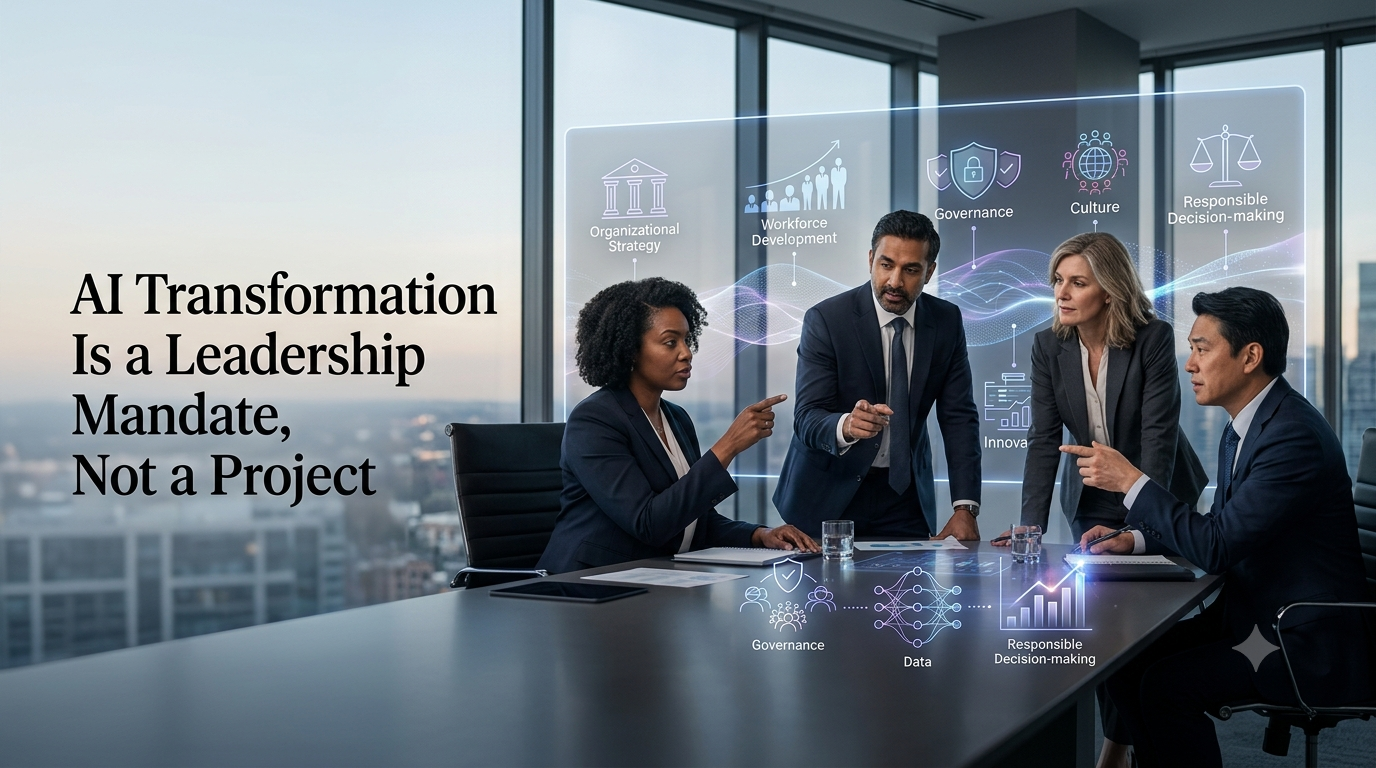
Artificial intelligence is rapidly moving from experimentation to mainstream organizational use. According to Stanford University’s 2025 AI Index, 78% of organizations reported using AI in 2024, compared with 55% in 2023. Generative AI use also increased significantly, with 71% of respondents reporting its use in at least one business function.
The message is clear: AI is no longer a distant technology trend. It is becoming part of how organizations operate, compete, make decisions, deliver services, educate people, conduct research, and create value.
How AI Transformation Works
Many organizations still make a fundamental strategic mistake to treat AI transformation as a project. Typically, an AI task force is created, a budget is allocated, and a technology platform is selected. The organization then launches a pilot project and evaluates it against implementation milestones. Once the initial objectives are achieved, the organization may consider the work complete. However, AI transformation does not work that way.
AI transformation is not a project with a beginning and an end. Instead, it is an ongoing organizational change that requires continuous leadership ownership.
The Core Difference: A Project Can Be Completed. Transformation Cannot.
In fact, projects are designed to deliver specific outcomes. They have:
- A defined scope
- A budget
- A project team
- A timeline
- Performance milestones
- A completion date
More specifically, transformation is fundamentally different. It changes how an organization operates. It influences how decisions are made and how employees work. Similarly, it also concentrate about how knowledge is managed and how services are delivered. Finally, it emphasis that how future value is created. This is particularly important in the age of artificial intelligence. In other words, AI is not simply another software application.
Unlike conventional digital technologies, AI increasingly influences knowledge intensive work, analysis, decision making, communication, creativity, automation, research, and customer or stakeholder interaction. When a technology affects nearly every organizational function, responsibility for that technology cannot remain isolated within one department.
Threfore, AI transformation must move from the project portfolio to the leadership agenda.
AI Adoption Is Not the Same as AI Transformation
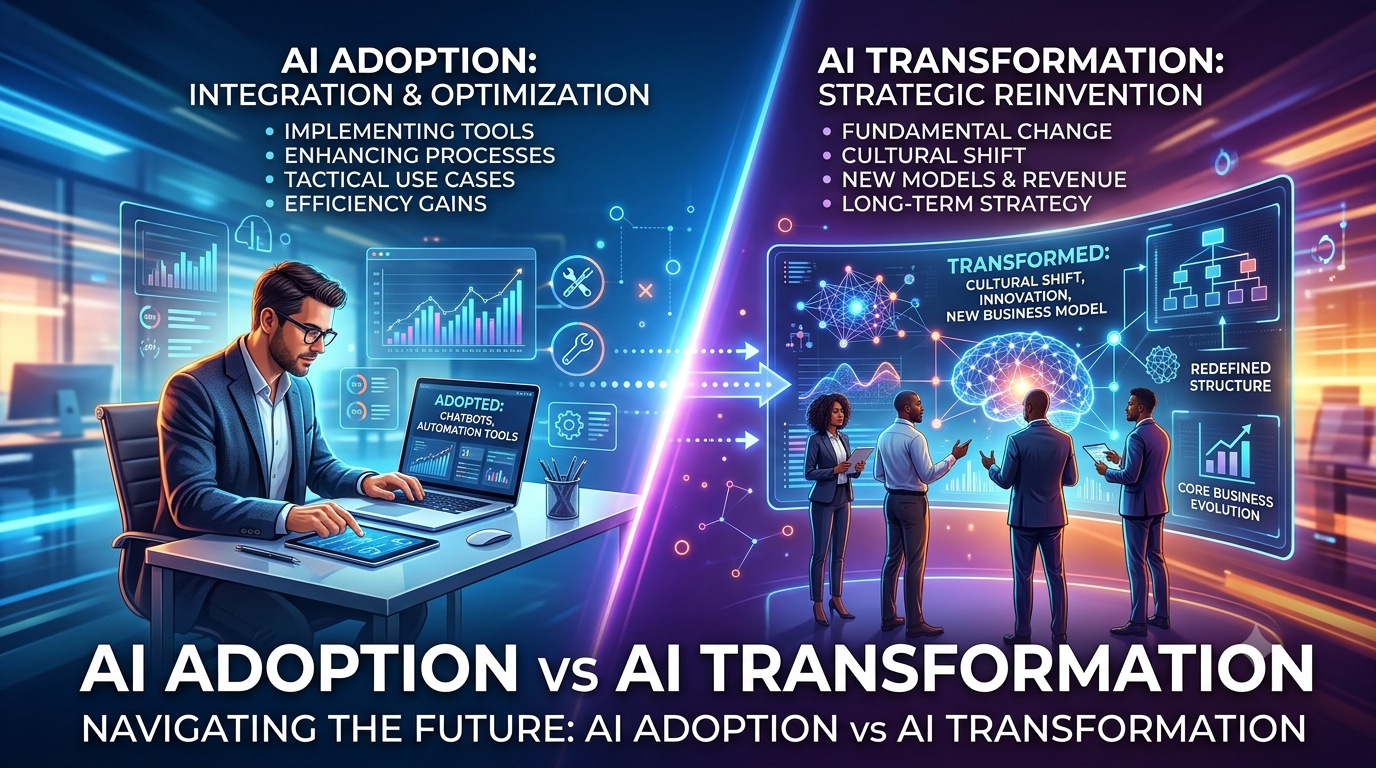
Indeed, one of the biggest misconceptions surrounding artificial intelligence is the assumption that implementing AI tools automatically creates AI transformation. In reality, It does not. There is a significant difference between AI adoption and AI transformation.
AI Adoption
AI adoption means introducing AI into existing workflows. For example:
- Using a generative AI assistant to write reports, office documents, emails, corresponding documents, letters or any other document used on daily working in your organization.
- Implementing an AI chatbot in daily routine tasks to provide data and information to your peers, other organizations, peoples associated with you, stakeholders and customers.
- Deploying predictive analytics for decision making.
- Automating document processing to make process easier, user friendly, fast and accurate.
- Using AI to analyze customer or student data to assess their needs and further improvement.
Overall, these initiatives can improve productivity and efficiency, but the organization itself may remain unchanged.
AI Transformation
In particular, AI transformation occurs when an organization fundamentally rethinks its capabilities, processes, workforce, governance, and strategy because AI has changed what is possible.
For example, a university implementing a chatbot on its website is adopting AI.
A university redesigning academic advising, student support, administrative workflows, research systems, knowledge management, and personalized learning around responsible human-AI collaboration is pursuing AI transformation.
Therefore, the difference is profound.
Adoption asks: “Where can we use AI?”
Transformation asks: “How should our organization evolve because AI now exists?”
Ultimately, this is the question leadership must answer.
The Evidence: AI Adoption Is Accelerating Faster Than Organizational Transformation
Indeed, the speed of AI adoption is remarkable. Stanford University’s 2025 AI Index reports that organizational AI use increased from 55% in 2023 to 78% in 2024. The use of generative AI in at least one business function increased from 33% to 71% during the same period.
However, widespread adoption does not necessarily mean organizations have achieved widespread transformation. The same AI Index evidence suggests that while organizations are beginning to experience financial benefits from AI, many remain in the early stages of capturing significant value.
Adoption Does Not Guarantee Transformation
So, this is an important leadership lesson.
“Deploying AI is relatively easy compared with transforming an organization around AI-enabled capabilities”.
Therefore, organizations can purchase tools quickly. They can subscribe to AI platforms, develop pilots projects and deploy chatbots. In other words, transforming culture, redesigning workflows, developing workforce capabilities, building governance mechanisms, and aligning AI with organizational strategy requires sustained leadership. The challenge, therefore, is not simply technological adoption but organizational readiness.
Why AI Transformation Must Start at the Top
Notably, AI affects the areas traditionally governed by organizational leadership. It influences strategy, workforce planning, organizational culture, financial investment, operations, risk management, data governance, innovation, research, education and learning and customer and stakeholder engagement.
AI Requires Cross-Functional Leadership
Therefore, AI cannot remain the responsibility of the IT department alone. Technology teams should build and manage the technical infrastructure, while data scientists should develop and evaluate AI models. IT teams should ensure security and integration. Legal and governance teams should manage compliance and risk. Human resource and academic leaders should support workforce development. Finally, leadership must provide the strategic direction.
Risk Management Framework
The National Institute of Standards and Technology’s AI Risk Management Framework reinforces this perspective. Its AI governance model identifies organizational management, senior leadership, and boards as key actors responsible for AI governance.
More importantly, NIST describes governance as a cross-cutting function. Organizations should not add governance only after they develop an AI system. It should influence the entire lifecycle of AI systems. NIST also emphasizes that senior leadership establishes the organizational tone for risk management and organizational culture. This is precisely why AI transformation cannot be delegated entirely to technical teams.
Therefore, Technology teams can implement AI and only leadership can transform an organization through AI.
The Leadership Problem: Fragmented AI Creates Fragmented Organizations
Although, in many organizations, AI adoption begins organically but one department experiments with generative AI and another purchases an analytics platform. A research group develops machine learning models, whereas employees begin independently using AI tools. On the other hand, students, faculty members, managers, and staff introduce AI into their individual workflows.
The Risks of Fragmented AI Adoption
In simple terms, innovation increases but fragmentation also increases. Ultimately, without leadership direction, organizations may eventually face:
Multiple disconnected AI tools
Duplicate technology investments
Inconsistent AI policies
Data privacy concerns
Shadow AI usage
Unclear accountability
Uneven workforce capabilities
Ethical and governance risks
Therefore, the problem is not that employees are experimenting with AI. The challenge is to build organizational AI capability while helping employees develop practical skills. Particularly, prompt engineering and effective human-AI interaction are becoming increasingly important capabilities for knowledge workers. Additionally, organizations should encourage employees to develop and apply these skills responsibly.
Notably, the problem occurs when experimentation becomes the organization’s AI strategy. Experimentation creates possibilities, but leadership creates direction. Finally, a successful AI transformation strategy requires leadership to connect experimentation with institutional priorities and long-term organizational value.

From AI Projects to AI Capability
Aboveall, one of the most important mindset shifts leaders must make is moving from thinking about AI projects to thinking about AI capabilities. An AI project asks “What solution can we build?”, whereas, an AI capability asks “What must our organization become capable of doing repeatedly?”
For example, instead of launching a single AI project, an organization may need to develop permanent capabilities in Data management, AI literacy, Machine learning and analytics, Generative AI, AI governance, AI ethics, Model evaluation, Cybersecurity, Human-AI collaboration, Process redesign and Change management
Eventually, these are not temporary requirements but emerging organizational capabilities. In other words, AI transformation should increasingly be viewed in the same way organizations view financial management, cybersecurity, strategic planning, or human resource development. Overall, these are not projects but ongoing organizational responsibilities.
The Four Leadership Responsibilities in AI Transformation
1. Strategic Direction: Leadership Must Define Why AI Matters
Importantly, organizations should not adopt AI simply because competitors are doing so. Therefore, leadership must define where AI creates meaningful value.
This requires answering strategic questions such as:
- Which organizational problems should AI help solve?
- Which processes should be redesigned?
- Where can AI improve quality and decision-making?
- Which new services or capabilities can AI enable?
- What should remain primarily human?
- How does AI support the organization’s long-term mission?
Hence, without strategic direction, AI investments can become collections of disconnected experiments. Indeed, leadership must therefore ensure that AI initiatives are linked to measurable organizational priorities.
Aboveall, the starting point for AI transformation is not technology selection. It is strategic intent.
2. Organizational Capability: Leadership Must Prepare People
In particular, leaders often discuss AI transformation as a technology challenge.In reality, it is equally a people challenge. The value of AI depends heavily on the ability of employees to work effectively with it. Organizations, therefore, need to invest in AI literacy, Digital skills, Critical thinking, Data literacy, AI evaluation skills, Ethical awareness and Human-AI collaboration
The future workforce will not simply consist of people who know how to use AI tools, but it will require people who know how to question, evaluate, verify, supervise, and responsibly collaborate with AI systems. Therefore, this makes workforce development a leadership responsibility. So, an organization cannot become AI-enabled if its people are not prepared for AI-enabled work.
3. Governance: Leadership Must Build Trust Before Scale
In fact, the faster AI is deployed, the more important governance becomes. AI introduces potential concerns related to Privacy, Security, Bias, Transparency, Reliability, Intellectual property, Accountability, Data quality and Human oversight. NIST’s AI Risk Management Framework organizes AI risk management around four interconnected functions such as Govern, Map, Measure, and Manage.
Importantly, organizations should treat governance as a cross-cutting function rather than a final compliance activity. So, this offers an important lesson for leaders. Therefore, governance should not slow down AI transformation. Good governance makes responsible AI transformation scalable. Organizations that build trust, accountability, and risk management into their AI strategy are better positioned to expand AI adoption sustainably.
4. Culture: Leadership Must Make AI Transformation Everyone's Responsibility
Certainly, technology transformation frequently fails because organizations focus on tools while ignoring culture. AI transformation requires employees to experiment, but organizations must guide experimentation within responsible boundaries. Therefore, employees need to feel comfortable learning new technologies and they should be encouraged to identify opportunities. Furthermore, employees should understand where AI can assist their work and AI’s limitations.
Leadership must, therefore, create a culture that balances innovation with responsibility, experimentation with governance, automation with human oversight and efficiency with ethics. So, the most successful AI-enabled organizations will not necessarily be those that automate the most tasks.
In other words, they belong to such organizations that develop the strongest ability for humans and AI systems to work together.
AI Transformation Requires a New Leadership Mindset
A key point is that leaders do not need to become machine learning engineers. For example,
- A Vice Chancellor does not need to train neural networks.
- A CEO does not need to develop large language models.
- A Dean does not need to write Python code to lead AI transformation.
But leaders must understand the strategic implications of AI and they must understand enough to ask the right questions. For example:
- Where can AI create value?
- Where can AI create risk?
- What data does our organization have?
- What data should never be used?
- Which decisions should remain human-led?
- How will we measure AI impact?
- Are employees prepared?
- Are our governance structures ready?
- Are our AI initiatives aligned with strategy?
- What organizational capabilities are we building for the future?
Finally, the AI era does not require every leader to become a technologist but it requires leaders to become AI literate decision makers
The Cost of Delegating AI Transformation
Undoubtably, delegating AI transformation entirely to an IT department creates a dangerous gap between technology and strategy. The IT department may successfully deploy systems but IT alone cannot determine:
- How the organization’s business model should evolve
- Which capabilities employees require
- How work should be redesigned
- What ethical boundaries should govern AI
- How organizational culture should change
- Which strategic priorities deserve AI investment
The leadership must answer these questions to take decisions. Similarly, creating an isolated “AI department” can also be insufficient. so, AI expertise is essential, but an AI team cannot transform the organization alone.
Therefore, AI transformation succeeds when AI expertise is centralized where necessary but AI responsibility is distributed across the organization. A key point is, leadership must provide the common direction that connects these efforts.
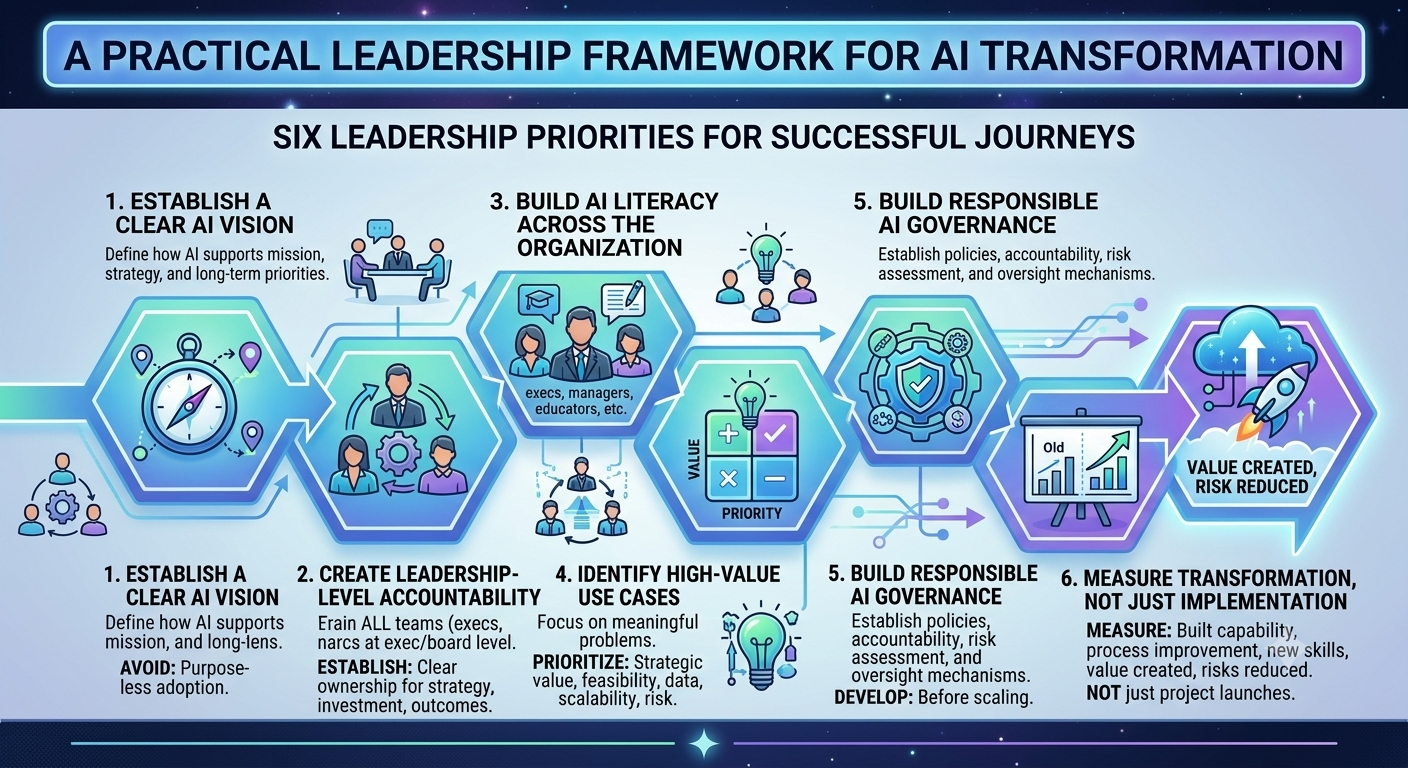
A Practical Leadership Framework for AI Transformation
1. Establish a Clear AI Vision
- Define how AI supports the organization’s mission, strategy, and long-term priorities.
- Avoid adopting AI without a clear purpose.
2. Create Leadership-Level Accountability
- Executives and board members should actively discuss AI strategy and its organizational impact.
- It should not exist only as a technical agenda.
- Establish clear accountability for AI strategy, governance, investment, and outcomes.
3. Build AI Literacy Across the Organization
- Organizations should extend AI literacy beyond technical employees.
- Executives, managers, educators, researchers, administrators, and operational teams all need an appropriate level of AI understanding.
4. Identify High-Value Use Cases
- Focus on meaningful organizational problems rather than adopting AI for novelty.
- Prioritize initiatives based on strategic value, feasibility, data availability, risk, scalability and measurable impact
5. Build Responsible AI Governance
Develop policies, accountability structures, risk assessment processes, and human oversight mechanisms before AI deployment scales across the organization.
6. Measure Transformation, Not Just Implementation
Do not measure success simply by asking “How many AI projects did we launch?”
Instead ask:
- What organizational capability did we build?
- What processes improved?
- What decisions improved?
- What skills did employees develop?
- What value was created?
- What risks were reduced?
- What can the organization now do that it could not do before?
That is the real measure of transformation.
The AI Leadership Mandate
Above all, the organizations that will lead in the AI era will not necessarily be those that purchase the most AI tools. These are the organizations whose leaders understand that AI is changing the foundations of organizational capability. The future belongs neither to organizations that blindly automate everything nor to those that resist AI adoption. It belongs to organizations that deliberately redesign themselves around intelligent, responsible, and human-centered capabilities.
Why Leadership Ownership Matters
AI transformation is therefore, not a project that leadership can approve and then delegate.
- It is a strategic responsibility that leadership must own.
- A project can be completed.
- A transformation becomes part of how an organization evolves.
- A project can be delegated.
Leadership cannot.
- A project delivers an output.
- Transformation changes capabilities.
Leadership Shapes the AI-Ready Organization
The question facing leaders today is therefore no longer: “Which AI project should we launch?”. The more important question is: “What kind of organization must we become in an AI-driven world?”
The answer to that question cannot be found in a technology procurement document. It requires vision, courage., governance., investment in people and above all, it requires leadership.
Finally, AI transformation is not a project but It is a leadership mandate. Therefore, AI transformation should also be understood as part of a broader digital transformation strategy that reshapes how organizations create and deliver value.
Conclusion
Organizations exploring artificial intelligence should move beyond isolated tool adoption and develop long-term organizational capabilities. Artificial intelligence transformation is not defined by the number of tools an organization deploys, pilots it launches, or processes it automates. It is defined by whether the organization becomes more capable, adaptable, responsible, and prepared for the future. That change cannot be achieved through technology alone.
It requires leaders to establish a clear vision, align AI with organizational priorities, invest in people, redesign workflows, build trustworthy governance, and create a culture where experimentation is encouraged but accountability remains clear. The organizations that succeed will not be those that simply move fastest. They will be those that learn fastest, govern responsibly, and continuously connect AI adoption to meaningful human and organizational outcomes.
AI transformation is therefore not a one-time initiative to be completed and handed over. It is an ongoing leadership responsibility that must evolve as technologies, expectations, risks, and opportunities change. The central question is no longer whether an organization will use AI. The more important question is whether its leaders will shape that use deliberately—or allow fragmented tools, disconnected experiments, and unmanaged risks to shape the organization for them.
AI transformation is not an IT project, not a temporary program and not a task that leadership can delegate and forget. Finally, it is a continuing mandate to build an organization capable of using artificial intelligence intelligently, responsibly, and humanely.
Frequently Asked Questions
What is AI transformation?
AI transformation is the ongoing process of changing an organization’s strategy, capabilities, workflows, workforce, culture, and governance to use artificial intelligence effectively and responsibly. It goes beyond deploying individual AI tools or automating isolated processes.
Why is AI transformation a leadership responsibility?
AI affects organizational priorities, decision-making, workforce development, risk management, culture, and long-term competitiveness. Because these areas require executive direction, AI transformation cannot be treated solely as an IT responsibility.
How is AI transformation different from AI adoption?
AI adoption involves introducing AI tools into existing processes. AI transformation involves redesigning how the organization operates because AI has changed what is possible. Adoption may improve a task, while transformation builds lasting organizational capability.
What role should leaders play in AI transformation?
Leaders should establish a clear AI vision, align AI initiatives with organizational priorities, invest in workforce development, redesign workflows, create governance structures, manage risks, and ensure that AI produces meaningful human and organizational outcomes.
Can AI transformation be completed as a one-time project?
No. AI transformation is an ongoing responsibility. Technologies, regulations, risks, workforce expectations, and organizational needs continue to change, so leaders must continuously evaluate and adapt their AI strategy.
Why is technology alone insufficient for AI transformation?
Technology can provide tools and automation, but it cannot independently create strategic alignment, employee readiness, ethical accountability, or organizational trust. Successful transformation requires changes in leadership, culture, processes, skills, and governance.
How can organizations align AI with their priorities?
Organizations should begin by identifying important strategic challenges and determining where AI can create measurable value. AI initiatives should support the organization’s mission, improve outcomes, address meaningful problems, and include clear measures of success.
Why is workforce development important for AI transformation?
Employees need the skills to use, evaluate, supervise, and collaborate with AI systems. AI literacy, data literacy, critical thinking, ethical awareness, and change-readiness help employees adopt AI responsibly and contribute to continuous improvement.
What does trustworthy AI governance involve?
Trustworthy AI governance includes clear accountability, risk assessment, privacy and security protections, transparency, human oversight, bias management, data quality controls, and processes for monitoring AI systems throughout their lifecycle.
How can leaders encourage experimentation while maintaining accountability?
Leaders can create safe environments for experimentation by defining acceptable-use policies, approval processes, risk boundaries, documentation requirements, and review mechanisms. Leaders should encourage employees to test ideas while holding them responsible for how they use AI.
What risks arise when AI adoption is fragmented?
Fragmented AI adoption can lead to duplicated investments, inconsistent policies, privacy and security vulnerabilities, unclear accountability, incompatible systems, uneven employee capabilities, and disconnected initiatives that do not support organizational strategy.
How should organizations measure AI transformation?
Organizations should measure more than the number of tools deployed or pilots launched. Useful measures include improved processes, stronger decision-making, employee capability development, reduced risk, better service outcomes, increased adaptability, and measurable progress toward strategic goals.
What does it mean to build an AI-ready organization?
An AI-ready organization has a clear strategy, capable employees, reliable data, adaptable workflows, responsible governance, strong leadership, and a culture that supports learning and experimentation. It can use AI while maintaining human judgment, accountability, and trust.
Should leadership delegate AI transformation to an IT department?
Leadership can delegate technical implementation, but it should not delegate strategic ownership. IT teams manage infrastructure and integration, while executives must determine priorities, governance expectations, workforce implications, ethical boundaries, and desired organizational outcomes.
What is the central leadership question in AI transformation?
The central question is not simply whether an organization will use AI. It is whether leaders will shape AI use deliberately or allow disconnected tools, unmanaged experimentation, and unaddressed risks to shape the organization instead.
What is the main conclusion about AI transformation?
AI transformation is not an IT project, temporary program, or task that leadership can complete and forget. It is a continuing mandate to build an organization capable of using artificial intelligence intelligently, responsibly, and humanely.