
Many educators, accreditation coordinators and administrators use the terms output and outcome interchangeably, although they have distinct meanings in Outcome-Based Education (OBE) and Quality Assurance (QA).
Introduction
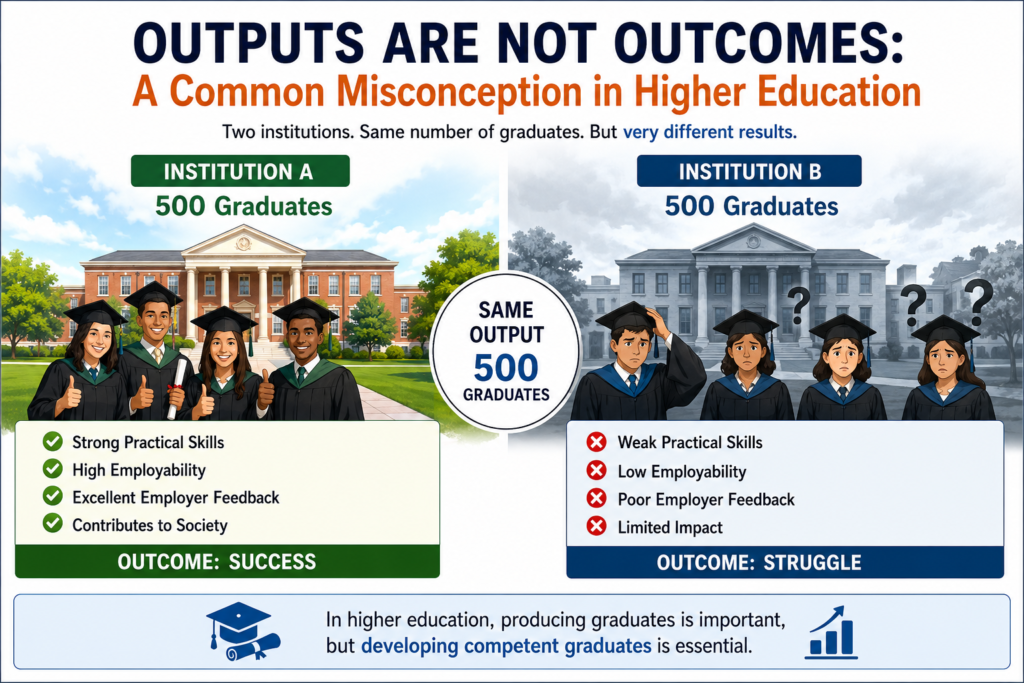
Every year, institutions proudly report how many students they graduate, how many workshops they conduct, and how many research papers they publish. But do these numbers actually prove educational quality? To answer the question Imagin two higher education institutions of the country. Both graduate 500 students every year. At first glance, both appear equally successful.
However, after six months of graduation, graduates from one institution are employed by a leading organization. These graduates demonstrate strong professional competencies and receive excellent employer feedback whereas, the graduates from the other institution struggle to secure the employment because they lack the practical skills required by industry. Although, both institutions produced the same number of graduates but they achieved very different educational results.
This example highlights one of the most important and critical discussion topics in modern higher education that is “the difference between educational outputs and educational outcomes”. In this modern era of Outcome-Based Education (OBE), quality assurance is no longer measured by how much an institution produces but by the value it creates through students learning, competence and societal impact.
This learner-centered philosophy is consistent with internationally recognized higher education frameworks such as the ABET Accreditation Criteria, the Washington Accord, the Seoul Accord, the CDIO Framework, and quality recommendations published by UNESCO and the OECD. These frameworks emphasize that educational quality should be evaluated based on graduates’ knowledge, skills, competencies, and their ability to apply learning in professional practice rather than merely on institutional activities or numerical achievements.
Why Do People Confuse About Outputs and Outcomes
Most educators, accreditation coordinators and administrators assume that if students complete courses, graduate, or attend workshops, educational success has been achieved. These are very valuable accomplishments, but these are outputs rather than outcomes. So, we can elaborate output as it indicates activities taken place whereas, outcomes indicates that learning has actually occurred. Furthermore, output is concerned with keyword “How Many” whereas, outcome refers to “How much”. For example, how many students admitted in any institute and how many graduated? Whereas, how much knowledge and skill they acquired when graduated and got a job position in the industry.
Understanding Educational Outputs
Educational outputs are the direct and immediate products generated by educational activities. Output refers to the answers of the questions such as: “How many?”, “How much?”, “How often?”. Few examples are number of graduates, number of courses offered, number of faculty members, number of laboratories established, number of hours taught, number of assignments taken, number of workshops conducted, number of internships arranged, number of publications, number of students enrolled, number of students graduated and graduation ratio. So, output reflects the productivity of institution but it doesnot indicate educational effectiveness.
What Are Educational Outcomes?
Educational outcomes refer to the knowledge, skills, competencies, attitudes and professional abilities which a student develops as a result of education. Outcomes answer questions such as “What did student learn?”, “What can graduate do practically?”, “How has their competence improved?”, “What impact has education created?”. Examples includes graduates can design AI-based solution, students demonstrates critical thinking, graduates communicate effectively in multidisciplinary teams, students apply ethical principles in professional practices, graduates secure employment in AI-related industries. Unlike outputs, outcomes measures educational effectiveness rather than institutional activities.
Outputs vs Outcomes: A Side-by-Side Comparison
The following table showed the side by side comparison of output and outcomes. The comparison is made on the basis of certain aspects.
Aspect | Educational Outputs | Educational Outcomes |
Focus | Activities completed | Learning achieved |
Measures | Quantity | Quality |
Question | What was produced? | What changed? |
Nature | Short-term | Medium- and long-term |
Evidence | Counts and statistics | Competencies and impact |
OBE Importance | Supporting evidence | Primary evidence |
Accreditation Value | Useful | Essential |
More Real-World Examples
Let’s look into an example to understand the difference between output and outcome. Consider an Artificial Intelligence course. In this course the output refers to following considerations.
- Fifty students completed the course.
- Twenty AI projects were submitted.
- Five laboratory sessions were conducted.
- Four assignments were taken for each student.
- One presentation was conducted for each student.
Whereas, the outcome refers to following aspects.
- Students can develop machine learning models independently.
- Students can apply AI techniques to solve real-world problems.
- Students can evaluate AI solutions responsibly and ethically.
- Students can implement AI model in real-world problems.
- Student can develop AI model to solve any real-world problem.
Hence, course outputs indicate activity, while the outcomes demonstrate learning.
Why Outcomes Matter More Than Outputs in OBE
Outcome-Based Education begins by defining what graduates should know, understand, and be able to do upon completion of a degree program. Curricula, teaching methodologies, assessments and continuous quality improvement processes are then aligned to achieve these outcomes. This philosophy forms the foundation of many international accreditation and quality assurance systems. For example, ABET evaluates engineering and computing programs based on clearly defined student outcomes, while the Washington Accord recognizes accredited engineering programs that demonstrate graduate competency through outcome-based assessment. Similarly, the Seoul Accord, which focuses on computing and information technology education, requires evidence that graduates have achieved specified professional competencies. Likewise, the CDIO (Conceive–Design–Implement–Operate) Initiative promotes engineering education that emphasizes practical skills, real-world problem solving, and measurable learning outcomes.
In OBE system, success is not measured by teaching alone but by evidence that students have achieved the intended learning outcomes. This shift places learners and their competencies at the center of educational quality.
Outputs and Outcomes in Quality Assurance
Quality assurance framework emphasizes on outcomes instead of outputs. International organizations also advocate outcome-focused education. UNESCO emphasizes that quality education should equip learners with relevant knowledge, skills, values, and competencies that enable them to contribute effectively to society. Similarly, the Organization for Economic Co-operation and Development (OECD) encourages education systems to evaluate learners based on competencies, critical thinking, problem-solving ability, and lifelong learning rather than solely on completion rates or academic credentials. This is because stakeholders which includes students, employers, governments and accreditation bodies are interested in educational effectiveness. For example,
Graduation rates provide useful information for institution whereas employers satisfaction depends upon stronger evidence of program quality. Similarly, number of research publications indicates the productivity of faculty members but graduates innovation and professional success reflect educational impact in the industry. Furthermore, course completion shows the participation of student whereas outcome attainment demonstrates learning of student. Continuous quality improvement relies on analyzing outcome data to refine curricula, teaching methods and assessment practices.
Common Mistakes Institutions Make
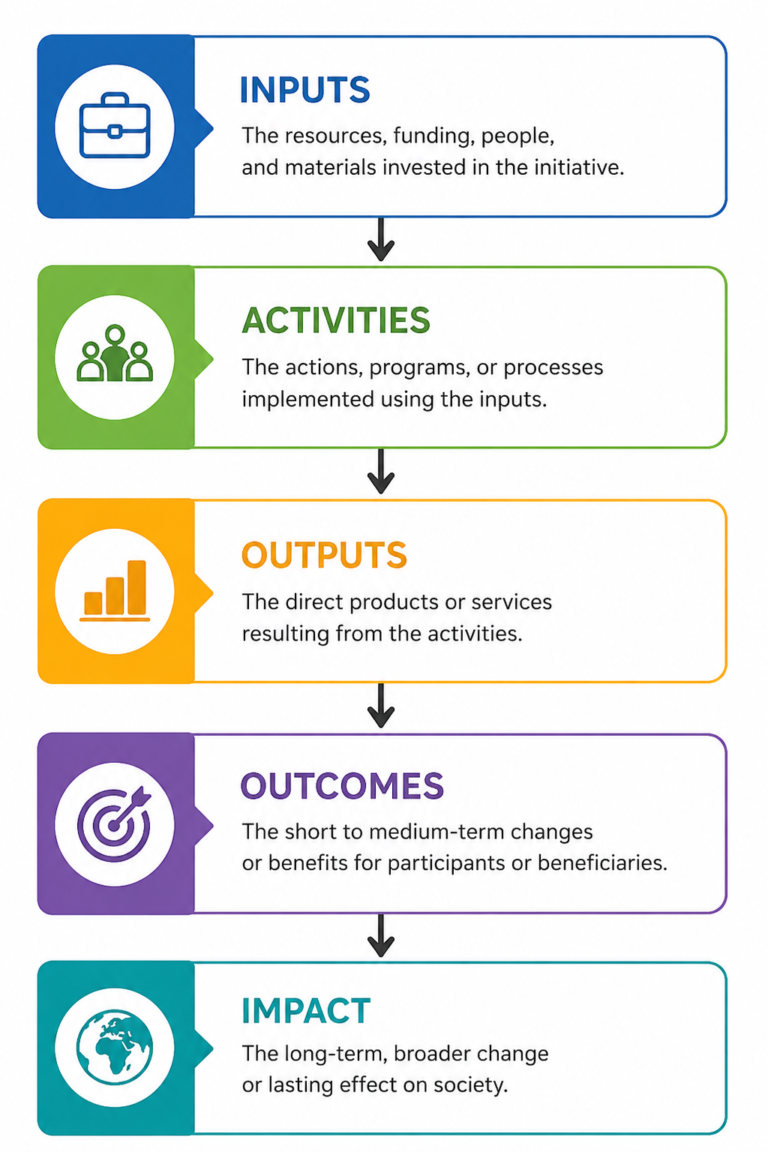
Many institutions normally focus on outputs while overlooking outcomes. Common examples include:
- Reporting the number of workshops conducted without evaluating whether participants gained new skills.
- Highlighting graduation statistics without assessing graduate competencies or employability.
- Measuring faculty members research productivity without considering its contribution towards students learning.
- Treating course completion as evidence of learning without collection outcome-based assessment data.
- Avoiding these factors helps institutions to build stronger quality assurance systems and supports meaningful and continuous improvement in quality, skills and learning.
Final Thoughts
Educational outputs and educational outcomes are complementary elements but both serves with different purposes. Outputs reflects that what an institution has produced, while outcomes demonstrates that value created through education. In Outcome-based Education and modern quality assurance systems, outcomes provide the most compelling evidence of educational effectiveness because they reflect what students know, what they can do and how they contribute to society. Institutions should monitor outputs but they should ultimately analyze success by measuring competencies, professional achievements and positive impact of their graduates. This outcome-oriented approach is consistent with globally accepted accreditation and quality assurance frameworks, reinforcing that educational excellence is demonstrated through graduates’ competencies, professional success, and positive societal impact rather than institutional productivity alone. In higher education, quality is defined not by the number of students who complete a program but by the difference the program makes in their lives and in the communities they serve.
Educational quality is not measured by the number of activities an institution performs, but by the measurable knowledge, skills, competencies, and values students acquire. Institutions committed to Outcome-Based Education should focus on evidence of learning and continuous improvement rather than simply reporting completed activities.
Frequently Asked Questions (FAQs)
1. What are outputs in higher education?
Outputs are the immediate results of educational activities, such as courses delivered, workshops conducted, research publications, or students graduated. They measure what an institution produces, not necessarily what students learn.
2. What are outcomes in education?
Outcomes are the measurable knowledge, skills, competencies, and behaviors students acquire after completing a course or academic program. They reflect the actual impact of learning.
3. Are outputs and outcomes the same?
No. Outputs represent completed activities or deliverables, while outcomes measure the changes or improvements achieved because of those activities. In Outcome-Based Education, outcomes are the primary measure of success.
4. Why does Outcome-Based Education focus on outcomes?
Outcome-Based Education focuses on outcomes because they demonstrate whether students have achieved the intended learning objectives and developed the competencies required for academic and professional success.
5. What is an example of an output and an outcome?
Output: A university conducts a cybersecurity workshop for 100 students.
Outcome: Students gain practical cybersecurity skills and successfully apply them in real-world projects or employment.
Author’s Note: The views and interpretations presented in this article are based on the author’s professional experience and publicly available educational frameworks. References to international accreditation bodies and educational organizations are provided for informational purposes only and do not imply endorsement or affiliation.