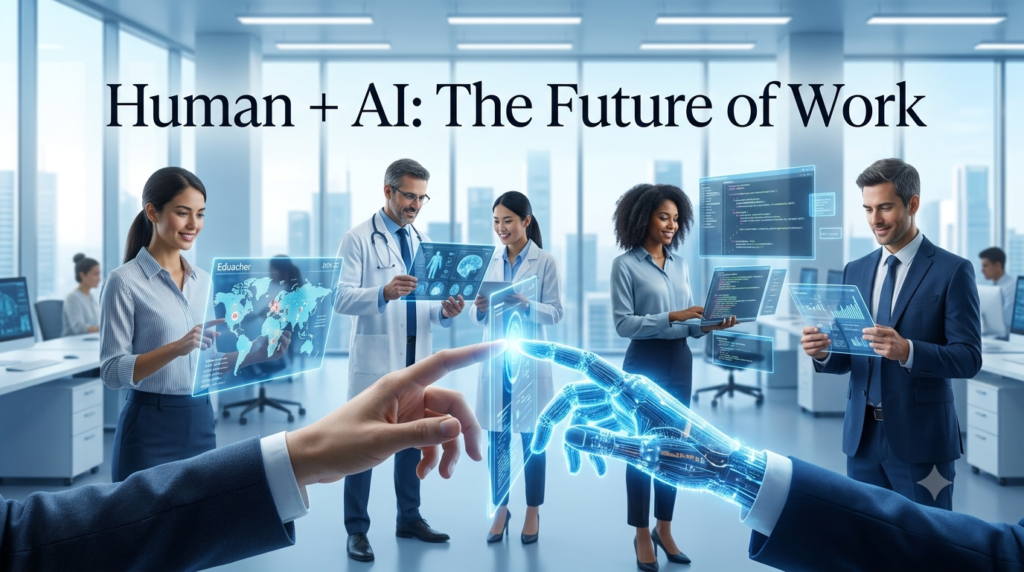
Will AI replace jobs? It is one of the biggest questions people are asking in 2026. Every day, headlines claim that Artificial Intelligence (AI) will replace teachers, doctors, engineers, programmers, writers, accountants, and many other professionals.
You have probably heard this statement on social media, news websites, television, YouTube, or even during conversations with friends and colleagues. Every day, headlines claim that Artificial Intelligence (AI) will replace teachers, doctors, engineers, accountants, writers, programmers, bankers, artists, factory workers, and even laborers.
If you are a student wondering whether your degree will still matter, a professional worried about your career, or a parent concerned about your child’s future, you are not alone. The fear is real but is it justified?
The short answer is simple: No.—not in the way many people imagine.
In reality, AI is changing the way we work, but it is not replacing human beings altogether. Instead, it is becoming a powerful assistant that helps people perform their jobs faster, more accurately, and more efficiently.
What Do Global Reports Say About Will AI Replace Jobs?
The fear that Artificial Intelligence (AI) will replace human workers is understandable. However, leading international organizations paint a more balanced picture. Rather than predicting widespread unemployment, they suggest that AI will transform jobs, change the skills people need, and create new opportunities alongside automation.
According to the World Economic Forum (WEF) Future of Jobs Report 2025, approximately 22% of today’s jobs are expected to be transformed by 2030 due to technological advancements, demographic changes, and other global trends. The report estimates that around 170 million new jobs will be created while about 92 million existing jobs may be displaced, resulting in a net increase of approximately 78 million jobs worldwide. In other words, many jobs will evolve rather than disappear.
Similarly, the International Labour Organization (ILO) emphasizes that generative AI is more likely to change the tasks people perform than eliminate entire occupations. While administrative and routine office work may be affected more significantly, most professions will continue to require human judgment, creativity, communication, and emotional intelligence.
The Organisation for Economic Co-operation and Development (OECD) also highlights that AI should be viewed as a tool that augments human capabilities. It encourages governments, employers, and educational institutions to invest in upskilling and reskilling so that workers can adapt to changing job requirements rather than be left behind.
Research from McKinsey reaches a similar conclusion. Instead of replacing workers entirely, AI is expected to automate repetitive tasks while allowing people to focus on work that requires problem-solving, creativity, collaboration, leadership, and decision-making. This shift is likely to increase productivity and redefine many roles instead of eliminating them.
The Microsoft Work Trend Index also reports that organizations are increasingly adopting AI as a workplace assistant to help employees draft documents, analyze data, summarize meetings, and automate routine work. The goal is not to replace employees but to enable them to spend more time on meaningful, strategic, and creative tasks.
These findings from the world’s leading organizations all point to one important conclusion: AI is changing work—not eliminating the need for people. So why are so many people still afraid? Let’s understand the reasons behind this fear.
AI is replacing certain tasks—not replacing people.
The future of work will belong to individuals who learn how to collaborate with AI, continuously develop new skills, and use technology to become more productive rather than viewing it solely as a threat.
AI Statistics in 2026 About Jobs and Automation
Artificial intelligence is transforming industries worldwide, but the evidence suggests that AI is more likely to reshape jobs than eliminate them entirely. Leading global organizations predict significant changes in the workforce, with automation replacing some tasks while creating new opportunities that require advanced digital and human skills.
| Organization | Key Finding |
|---|---|
| World Economic Forum (Future of Jobs Report 2025) | By 2030, AI and automation are expected to create approximately 170 million new jobs while displacing around 92 million, resulting in a net gain of 78 million jobs globally. |
| McKinsey Global Institute | Up to 30% of current work activities could be automated by 2030, requiring millions of workers to reskill or transition into new roles. |
| International Labour Organization (ILO) | AI is expected to augment most jobs rather than replace them, with clerical and administrative occupations experiencing the greatest transformation. |
| OECD | Around 27% of jobs in OECD countries are at high risk of significant transformation due to AI, emphasizing the growing importance of continuous learning and workforce adaptability. |
| Microsoft Work Trend Index 2025 | Most business leaders plan to expand the use of AI, and employees increasingly view AI as a productivity partner rather than a replacement for human expertise. |
Why Are People Worried That AI Will Replace Human Workers?
Imagine you wake up one morning and read these headlines:
-
AI writes better than humans.
-
AI creates images in seconds.
-
AI can write computer code.
-
AI answers customer questions instantly.
-
Companies are replacing workers with AI.
It’s natural to think that “If AI can do all these things, what will happen to my job?”. This fear comes from not fully understanding what AI actually does. Most people think AI is becoming another human. This is not the case. AI is not becoming another human being. Instead, it is becoming a powerful tool that helps humans work more efficiently.
How Previous Technologies Changed Jobs Before AI
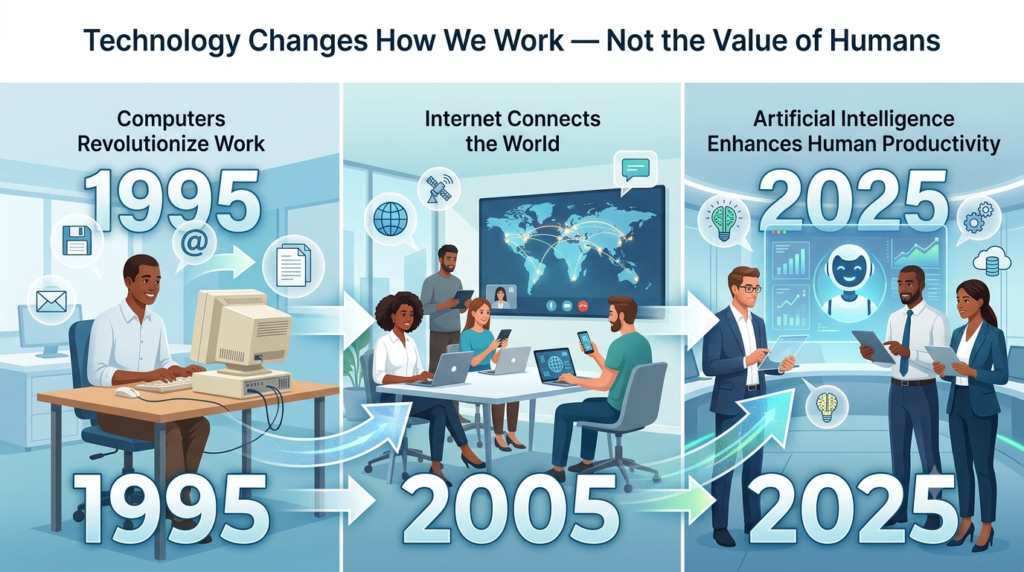
Imagine it is 1995. A shopkeeper hears about computers for the first time.
He says,
“Computers will replace accountants.”
Did they?
No.
Today almost every accountant uses a computer.
Similarly, imagine someone saying “Email will replace office workers.”
That never happened. Instead, office workers simply changed the way they communicated.
Furthermore, imagine someone saying that “Google will replace teachers.”
Did schools disappear? The answer is simple: No.. Universities still exist. Teachers still teach. Google simply made information easier to find. AI is following exactly the same path.
Technology rarely eliminates entire professions. More often, it changes how people do their work.
How AI Is Transforming Jobs Instead of Replacing Workers
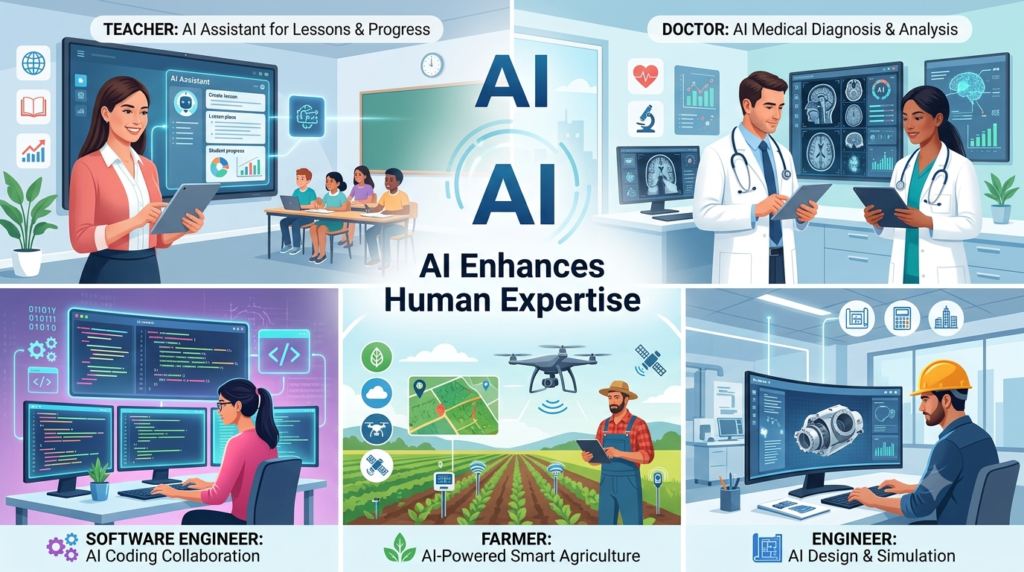
Think about a hospital. A doctor has to read patient records, study lab reports, review medical history, write prescriptions, explain treatment, comfort worried families, and make difficult decisions.
Now imagine AI helping by reading thousands of medical reports in seconds, highlighting possible diseases, suggesting treatment options and organizing patient records.
Who makes the final decision? Answer is “The doctor”. AI doesn’t replace the doctor. It saves the doctor time.
Example 1: Teachers
Without AI
A teacher spends:
- 3 hours preparing lecture slides
- 2 hours creating quizzes
- 4 hours checking assignments
- 2 hours writing reports
Total:
11 hours
Whereas, With AI
AI helps:
- Draft lecture slides
- Generate quiz questions
- Suggest grading rubrics
- Summarize assignments
Now the teacher spends:
- Reviewing
- Improving
- Explaining concepts
- Motivating students
- Answering questions
The teacher still teaches; Students still need someone who can inspire them, answer unexpected questions, encourage them during difficult times, and help them grow as individuals. AI cannot replace that human connection.
Example 2: Doctors
Can AI perform surgery?. The answer is simple No.
Can AI comfort frightened patients?. The answer is simple No.
Can AI understand a patient’s emotions?. The answer is “Not like a human doctor.”
AI can:
- Analyze X-rays
- Detect patterns
- Suggest diagnoses
But Patients trust human doctors because they provide reassurance, explain difficult decisions, understand emotions, and take responsibility for treatment. AI can support these decisions, but it cannot replace the human relationship between a doctor and a patient.
Example 3: Lawyers
Many legal documents contain hundreds of pages. AI can search them in seconds. But can AI stand in court?. Can AI negotiate with another lawyer?. Can AI understand human emotions during a family dispute?. The answer is “Not effectively.”
Lawyers will use AI and AI will not become lawyers.
Example 4: Farmers
Modern farms now use AI-powered drones, Smart irrigation systems, Weather prediction and Crop disease detection. Has farming disappeared?. The answer is “No.”
Farmers simply make better decisions.
Example 5: Software Developers
This surprises many people. AI can write computer code. So, are programmers becoming unemployed? Actually, many programmers are becoming more productive. Instead of spending hours writing repetitive code, they use AI to generate a first draft, then they review, improve, test, and secure it.
The programmer is still responsible for building reliable software.
Example 7: Factory Workers
Imagine a worker in a car manufacturing plant.
Twenty years ago, workers welded every part manually.
Today, robotic arms perform much of the repetitive welding.
Has the worker disappeared?
No.
Instead, many workers now:
- Operate robots
- Monitor production
- Perform quality inspections
- Maintain machines
- Solve technical problems
Their job has evolved rather than vanished.
Example 8: Student
Many of your readers will be students.
Example 8: Students
Imagine a university student struggling with mathematics.
Without AI, they may spend hours searching through books or videos.
With AI, they can ask questions, receive explanations in simple language, and practice additional problems.
Has AI earned the degree?
No.
The student still needs to study, understand concepts, and pass examinations.
AI becomes a tutor—not a substitute for learning.
Example: University Students Preparing for Careers
Before AI:
A student learns only textbook knowledge.
After AI:
A student learns:
Domain knowledge
AI tools
Problem solving
Critical thinking
Communication skills
Example:
A computer science student who knows programming + AI tools may outperform someone who only knows traditional programming.
Why AI Is Like a Calculator—Not a Human Replacement
When calculators became common, many feared students would forget mathematics. Did mathematicians disappear?. The answer is “No”. Calculators removed repetitive calculations. Humans focused on solving bigger problems. AI is like a much more advanced calculator. It reduces repetitive mental work so humans can focus on creativity, strategy, relationships, and decision-making.
What Jobs Will AI Replace?
Some jobs involve repetitive tasks.
Examples include:
- Data entry
- Basic customer support
- Routine report generation
- Simple bookkeeping
- Scheduling appointments
AI can automate many of these activities. However, automation doesn’t always eliminate jobs. It often changes them.
For example, a customer support representative may spend less time answering routine questions and more time resolving complex customer issues that require empathy and judgment.
What Jobs Can AI Not Replace?
Many careers rely heavily on human interaction, trust, ethics, and creativity.
These include:
- Teachers
- Doctors
- Nurses
- Engineers
- Scientists
- Architects
- Psychologists
- Managers
- Entrepreneurs
- Researchers
- Police officers
- Judges
- Social workers
- Skilled technicians
- Electricians
- Plumbers
AI can support these professionals—but it cannot fully replace the human qualities their work depends on.
What Human Skills Can AI Not Replace?
Despite its impressive abilities, AI has important limitations.
It cannot truly:
- Feel empathy
- Build genuine relationships
- Understand personal experiences
- Take moral responsibility
- Lead people through uncertainty
- Inspire teams
- Earn trust in the way humans do
These are qualities that remain uniquely human.
What Is the Real Risk in the AI Era?
The real risk is standing still while the world changes.
Consider two accountants.
Accountant A ignores AI completely. Everything is done manually.
Accountant B learns how to use AI to automate repetitive tasks, analyze financial reports faster, and prepare presentations more efficiently.
Both are accountants. But one completes the same work in half the time. If an employer has to choose, who is likely to be more valuable? The difference isn’t that AI replaced Accountant A.
It’s that Accountant B learned to use AI as a productivity tool.
How Can You Prepare for an AI-Powered Career?
Technology is best when it brings people together.” — Matt Mullenweg
The good news is that you don’t need to become an AI engineer. Instead, focus on learning how AI can assist you in your own profession.
Start by:
- Exploring one AI tool relevant to your work.
- Practicing how to write effective prompts.
- Using AI to automate repetitive tasks.
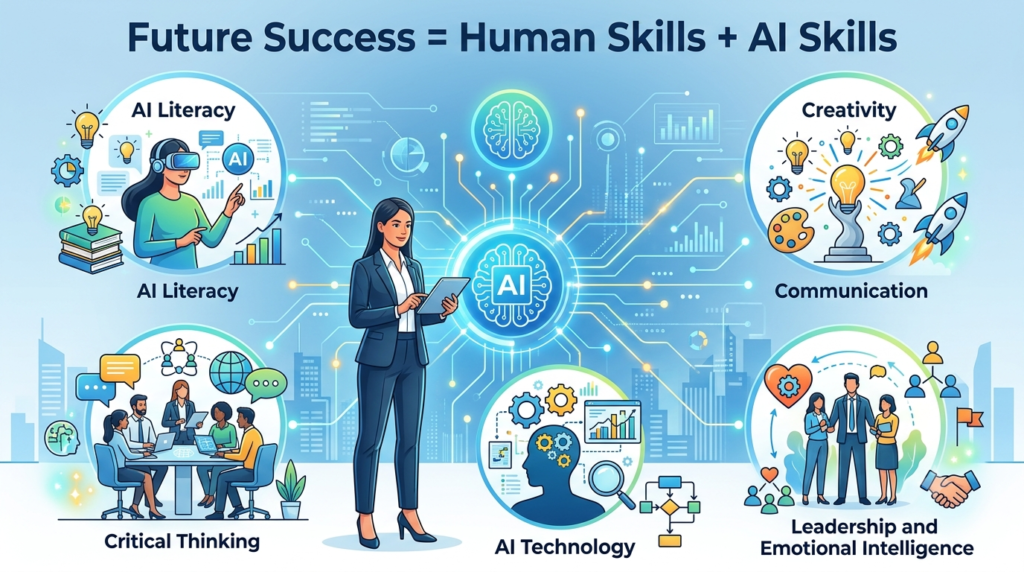
- Strengthening skills that AI cannot replicate, such as communication, leadership, creativity, and critical thinking.
- Staying curious and continuing to learn as technology evolves.
Small, consistent steps can make a significant difference.
How to Thrive in the Age of Artificial Intelligence
Instead of asking, “Will AI take my job?”
Ask, “How can AI help me do my job better?”
That single shift in mindset changes fear into opportunity.
Final Thoughts: Will AI Replace Jobs or Transform Them?
Every major technological revolution has brought uncertainty. The printing press changed education. Electricity transformed industries. Computers reshaped offices. The internet connected the world. Smartphones changed communication. Each innovation created new ways of working rather than eliminating the need for people. Artificial Intelligence is following the same pattern. It will automate some tasks, reshape many jobs, and create entirely new opportunities. But the future is unlikely to belong to AI alone—or to humans working without technology. It belongs to people who know how to combine their knowledge, creativity, ethics, and judgment with the capabilities of AI. The question is no longer whether AI will be part of our working lives. It already is. The real question is whether we choose to fear it—or learn to work alongside it.
Remember This AI is not your replacement. It is your assistant. Your experience, judgment, compassion, and creativity are still the qualities that make you irreplaceable. The future of work is not Human vs. AI but It is Human + AI.
Frequently Asked Questions About AI and Jobs
1. Will AI replace most jobs?
No. AI will automate many tasks, but most jobs will change rather than disappear.
2. Which jobs are most affected by AI?
Jobs involving repetitive and routine tasks, such as data entry and basic administrative work, are more likely to be affected.
3. Can AI replace teachers and doctors?
No. AI can assist teachers and doctors, but it cannot replace human expertise, empathy, and decision-making.
4. What skills are important in the AI era?
AI literacy, critical thinking, creativity, communication, and problem-solving are essential skills.
5. How can students prepare for an AI-driven future?
Students should learn AI tools, develop digital skills, and strengthen human skills like creativity and collaboration.
Author’s Note: The views and interpretations presented in this article are based on the author’s professional experience and publicly available educational frameworks. References to international accreditation bodies and educational organizations are provided for informational purposes only and do not imply endorsement or affiliation.