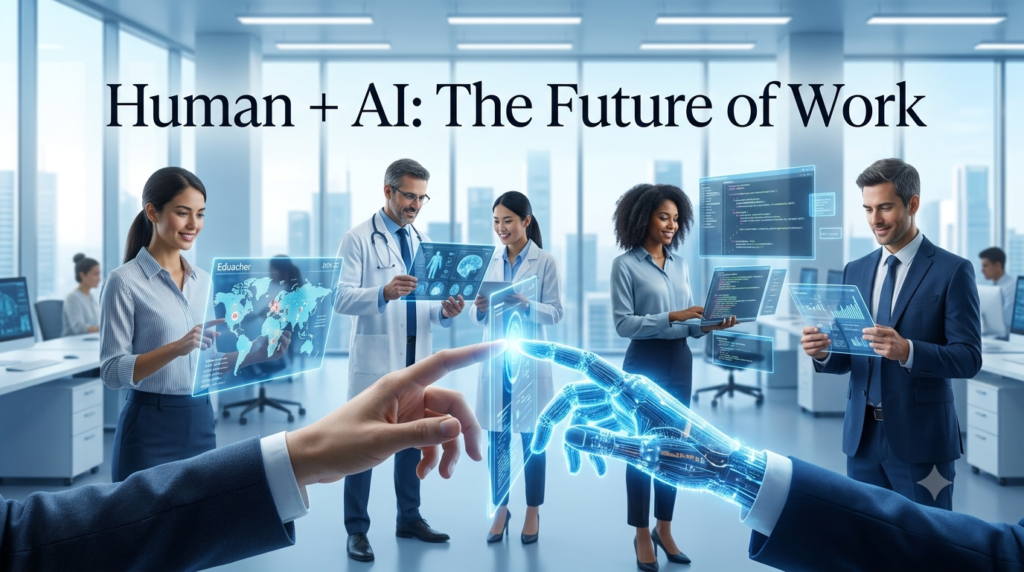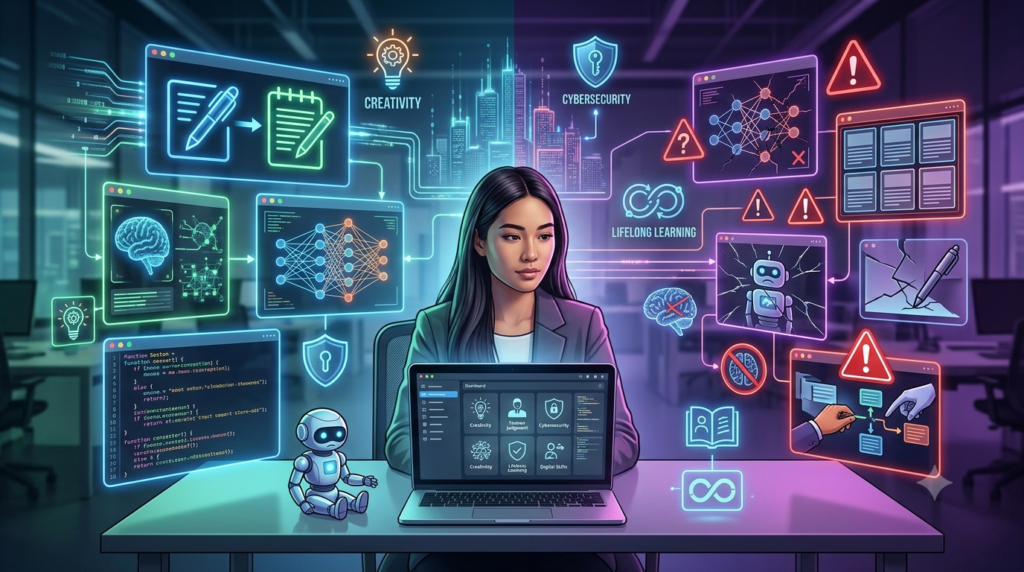
Today, AI literacy has become an essential skill in 2026 as artificial intelligence continues to transform education, workplaces, businesses and everyday life. Understanding how AI works, evaluating its outputs, and using AI responsibly are now important abilities for students, professionals and organizations.

Why AI Literacy Matters Today
As AI becomes increasingly integrated into education, healthcare, finance, manufacturing, agriculture, software development, and countless other industries, a new form of literacy has become essential—AI literacy.
Just as digital literacy became a fundamental skill during the internet revolution, AI literacy is now emerging as one of the most important competencies for students, educators, professionals, business leaders, and policymakers. Understanding AI is no longer limited to computer scientists or software engineers. Regardless of your profession, you need to know what AI is, how it works, what it can and cannot do, and how to use it responsibly.
Unfortunately, many people begin using AI tools without understanding their capabilities, limitations, or ethical implications. They often assume that AI-generated content is always accurate, unbiased, or complete. In reality, AI systems can make mistakes, produce misleading information, reflect biases present in training data, or generate convincing but incorrect responses. Using AI effectively therefore requires more than simply entering prompts—it requires critical thinking, informed judgment, and responsible decision-making.
This comprehensive guide explains the fundamentals of AI literacy in simple, practical language. You’ll learn what AI literacy means, why it matters, its core components, common misconceptions, and practical strategies for developing AI skills that will remain valuable throughout your career. Whether you are a student beginning your AI journey, an educator integrating AI into teaching, or a professional seeking to remain competitive in an AI-driven workplace, this guide will help you build a strong foundation for lifelong learning.
AI literacy is not about becoming an AI engineer. It is about understanding artificial intelligence well enough to use it effectively, evaluate it critically, and apply it responsibly in education, work, and everyday life.
What Is AI Literacy?
Artificial Intelligence (AI) has become one of the most influential technologies of the 21st century. However, simply using AI tools does not mean a person is AI literate. True AI literacy goes beyond interacting with chatbots or generating images—it involves understanding how AI works, recognizing its strengths and limitations, evaluating its outputs critically, and using it responsibly and ethically.
As AI becomes increasingly integrated into education, healthcare, business, finance, manufacturing, agriculture, and public services, AI literacy is emerging as a fundamental life and career skill. Similar to reading, writing, and digital literacy, AI literacy equips individuals with the knowledge and confidence to navigate an AI-driven world.
AI literacy refers to the ability to understand, evaluate, use, and interact with artificial intelligence technologies effectively, responsibly, and ethically.
An AI-literate person understands:
- What artificial intelligence is.
- How AI systems learn and make predictions.
- Where AI is used in everyday life.
- What AI can and cannot do.
- How to verify AI-generated information.
- The ethical, legal, and social implications of AI.
- How to use AI as a tool for learning, productivity,
and innovation.
Importantly, AI literacy does not require advanced programming skills or expertise in computer science. Instead, it focuses on developing informed users who can work effectively with AI technologies regardless of their profession. AI literacy is the knowledge and skills required to understand, evaluate, and use artificial intelligence safely, effectively, and responsibly.
Why AI Literacy Matters in 2026
Artificial Intelligence is rapidly becoming a part of everyday life, education, and professional work. In 2026, the importance of understanding artificial intelligence has increased because people need to understand how AI works, use AI tools effectively, and make responsible decisions when interacting with intelligent systems. Just as digital literacy became essential during the internet era, AI literacy is becoming a fundamental skill in the AI-driven world. It helps individuals move beyond simply using AI tools and develop the ability to evaluate, question, and apply AI responsibly.
How AI Knowledge Improves Career Opportunities
AI is transforming jobs across almost every industry. Professionals who understand AI can improve productivity, automate repetitive tasks, analyze information, and collaborate effectively with AI-powered tools. These AI-related skills help people:
- Adapt to changing workplace technologies.
- Use AI tools more effectively.
- Improve problem-solving and creativity.
- Develop skills needed for future careers.
Understanding AI Supports Critical Thinking
However, AI systems can generate impressive results, but they can also produce inaccurate or biased information. AI-literate individuals know how to verify information, identify limitations, and apply human judgment before making decisions. This skill is especially important in areas such as education, healthcare, business, and research.
Responsible and Ethical AI Use
Understanding AI also means understanding its ethical challenges, including:
- Data privacy.
- AI bias.
- Copyright issues.
- Security risks.
- Responsible decision-making.
This knowledge helps users apply artificial intelligence in a fair, safe, and ethical manner.
AI Improves Learning and Productivity
Furthermore, Students, teachers, and professionals can use AI to support learning, research, communication, and creativity. However, effective AI use requires knowing when to trust AI outputs and when human expertise is necessary.
AI Literacy Is More Than Using ChatGPT
One of the most common misconceptions is that someone becomes AI literate simply by using AI tools like ChatGPT or Microsoft Copilot. Using an AI application is only the starting point.
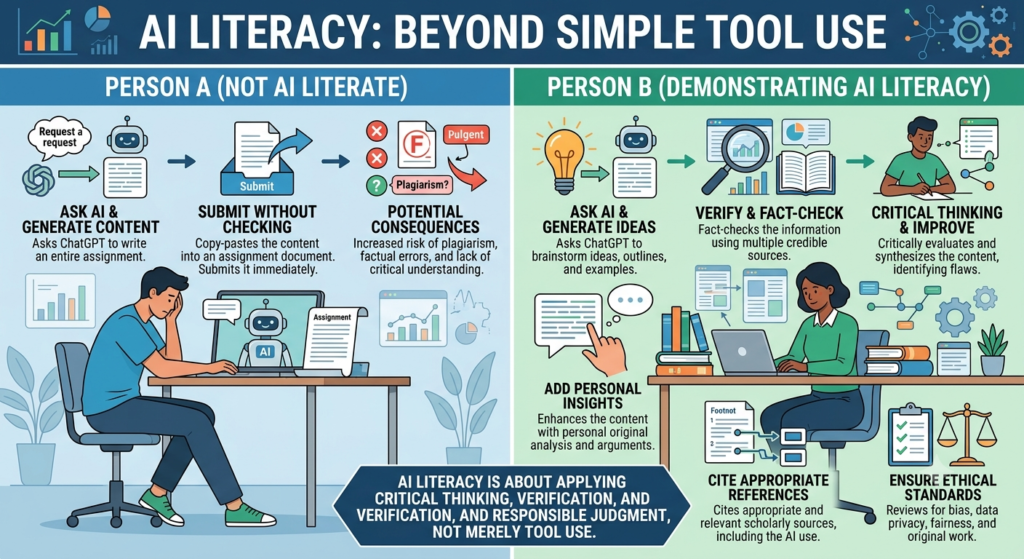
Consider the following example:
Person A asks ChatGPT to write an assignment and submits the response without checking it.
Person B asks ChatGPT to generate ideas, verifies the information using reliable sources, improves the content with personal insights, cites appropriate references, and ensures the work meets ethical standards.
Both individuals use the same AI tool, but only the second demonstrates AI literacy because they apply critical thinking, verification, and responsible judgment. This distinction highlights why responsible AI use is about how you use AI, not merely whether you use AI.
Many beginners unknowingly misuse AI by accepting AI-generated information without verification or relying on AI for every task. To avoid these common pitfalls, read our guide on Common AI Learning Mistakes: 8 Mistakes Beginners Should Avoid (2026 Guide) before integrating AI into your daily learning or work.
The Four Pillars of AI Literacy
Understanding artificial intelligence is built on four interconnected pillars.
1. Understanding AI Concepts
This involves learning the basic principles of artificial intelligence, including Artificial Intelligence, Machine Learning, Deep Learning, Neural Networks, Generative AI, Large Language Models (LLMs), Computer Vision and Natural Language Processing. You do not need to master the mathematics behind these technologies, but you should understand their purpose and real-world applications.
2. Critical Evaluation of AI Outputs
AI systems can produce impressive results, but they can also generate inaccurate, outdated, or biased information. AI-literate individuals know how to:
- Verify facts.
- Cross-check multiple sources.
- Identify hallucinations.
- Evaluate credibility.
- Recognize misinformation.
- Question AI-generated recommendations.
Critical evaluation prevents overreliance on AI and supports better decision-making.
3. Responsible and Ethical AI Use
Responsible AI use includes understanding:
- Data privacy
- Copyright
- Academic integrity
- Fairness
- Transparency
- Bias
- Accountability
- Human oversight
4. Practical Application of AI Tools
Effective use of AI also involves knowing when and how AI can improve productivity.
Examples include:
- Research assistance
- Writing support
- Programming
- Data analysis
- Presentation development
- Brainstorming
- Language translation
- Customer service
- Workflow automation
The goal is not to replace human expertise but to enhance it.
AI Literacy in Everyday Life
AI is already part of daily life, often without people realizing it. Examples include:
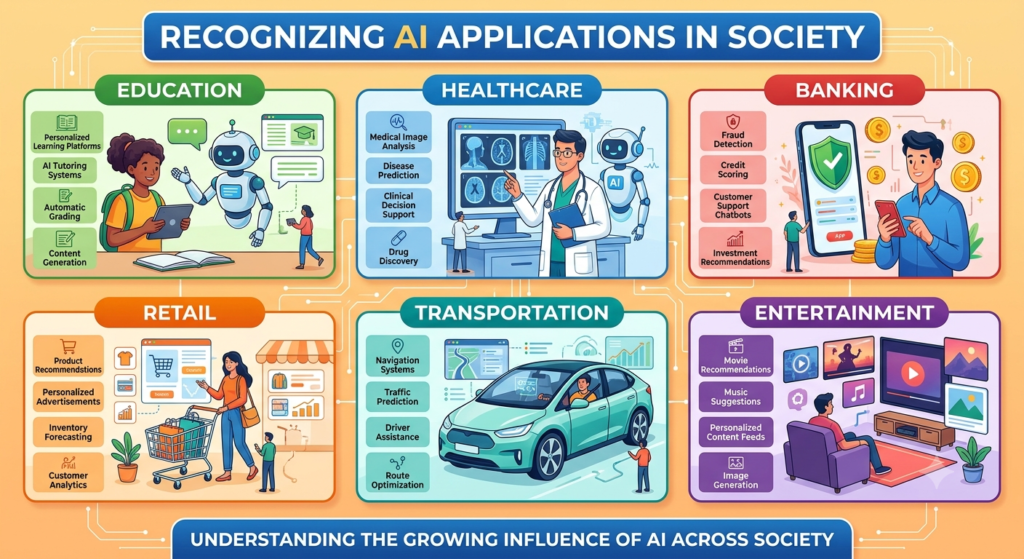
Education
- Personalized learning platforms
- AI tutoring systems
- Automatic grading
- Content generation
Healthcare
- Medical image analysis
- Disease prediction
- Clinical decision support
- Drug discovery
Banking
- Fraud detection
- Credit scoring
- Customer support chatbots
- Investment recommendations
Retail
- Product recommendations
- Personalized advertisements
- Inventory forecasting
- Customer analytics
Transportation
- Navigation systems
- Traffic prediction
- Driver assistance
- Route optimization
Entertainment
- Movie recommendations
- Music suggestions
- Personalized content feeds
- Image generation
Recognizing these applications helps individuals understand the growing influence of AI across society.
Why AI Literacy Is Different from Digital Literacy
Digital literacy focuses on the ability to use digital technologies effectively, including computers, software, the internet, and online communication. Artificial intelligence awareness builds upon digital literacy by introducing skills specific to artificial intelligence.
Digital Literacy | AI Literacy |
Using computers | Understanding AI systems |
Internet skills | Evaluating AI outputs |
Email communication | Prompt engineering |
Productivity software | Responsible AI use |
Online research | AI ethics and bias |
Think of digital literacy as the foundation, while AI literacy represents the next stage of technological competence.
AI Literacy by the Numbers
According to the World Economic Forum’s Future of Jobs Report 2025, AI and big data are among the fastest-growing skills expected to shape the global workforce over the coming years. Similarly, UNESCO emphasizes AI competencies as an essential part of future education systems. These developments highlight why AI literacy is becoming a core skill for lifelong learning and career success.
Characteristics of an AI-Literate Person
An AI-literate individual:
- Understands basic AI concepts.
- Knows AI’s strengths and weaknesses.
- Verifies AI-generated information.
- Uses AI responsibly.
- Protects personal and organizational data.
- Recognizes ethical challenges.
- Learns new AI technologies continuously.
- Combines AI with critical thinking.
- Uses AI to improve productivity rather than replace judgment.
These qualities enable professionals to use AI confidently and responsibly in academic, professional, and personal contexts.
Real-World Example
Imagine two university students conducting research for the same assignment.
Student A copies AI-generated text directly into the report without verification or citation.
Student B uses AI to generate ideas, consults scholarly sources, verifies facts, rewrites the content in their own words, and cites appropriate references.
Although both students use AI, only Student B demonstrates genuine responsible AI practices by applying ethical practices, critical thinking, and academic integrity. This example illustrates that effective AI use is not measured by the ability to generate content quickly but by the ability to use AI thoughtfully, critically, and responsibly..
Final Thought
AI literacy is not about replacing human intelligence with artificial intelligence. It is about empowering people to understand AI, think critically about its outputs, use it ethically, and apply it responsibly to solve real-world problems. As AI continues to transform every industry, AI literacy will become one of the most valuable competencies for lifelong learning, career success, and informed citizenship.
Frequently Asked Questions (FAQs)
What is AI literacy?
AI literacy is the ability to understand, evaluate, and responsibly use artificial intelligence technologies.
Why is AI literacy important?
Understanding AI helps individuals use AI effectively, identify misinformation, protect privacy, and make better decisions.
Do I need programming skills to become AI literate?
No. AI literacy focuses on understanding and using AI responsibly rather than developing AI systems.
Is AI literacy only for computer science students?
No. AI literacy is important for students, teachers, healthcare professionals, business leaders, and workers across all industries.
How can beginners develop AI literacy?
Beginners can develop AI-related skills by learning AI concepts, practicing with AI tools, improving prompt skills, and evaluating AI-generated information.
Author’s Note: The views and interpretations presented in this article are based on the author’s professional experience and publicly available educational frameworks. References to international accreditation bodies and educational organizations are provided for informational purposes only and do not imply endorsement or affiliation.